Yes, you need holes in your roof. It sounds completely backward — after all, isn't the whole point of a roof to keep the outside out? But the absolute truth is that a roof that can't breathe is a roof that's dying.
Most premature roof failures we see in Windsor aren't caused by cheap shingles or bad weather. They're caused by poor attic ventilation. When we step onto a roof and see the shingles frying from the inside out, we know exactly what the problem is. Here is the straight talk on why airflow is the secret to a roof that lasts.
Why Your Roof Needs to Breathe
Think of roof ventilation as a natural air conditioning system for your attic. Without it, your home suffers in two major ways:
- Summer Bake-Off: During a hot Windsor summer, the sun beats down on your shingles. If that trapped hot air has nowhere to go, your attic turns into an oven (often reaching 150°F+). This bakes the shingles from underneath, causing them to blister and curl, and forces your AC to work overtime.
- Winter Ice Dams & Mold: In the winter, heat and moisture from cooking and showering rise into your attic. If the attic is too warm, it melts the snow on your roof. That water runs down to the cold eaves and refreezes, creating massive ice dams. Worse, trapped moisture leads directly to black mold rotting your decking.
The Science of Airflow: How It Actually Works
A proper ventilation system relies on a simple rule of physics: hot air rises.
To create a continuous flow of air, you need two things: Intake (where cool air enters) and Exhaust (where hot air escapes). When cool air gets sucked into the bottom of the roof, it pushes the hot, humid air up and out through the top. It's an automatic, continuous cycle that keeps your attic temperature regulated year-round.
The Vents We Use to Protect Your Home
Not all roofs are built the same, so we use different types of vents to achieve the perfect balance of intake and exhaust.
1. The Intake: Soffit Vents
These are located under the overhang of your roof (the eaves). They pull fresh, cool air from the outside directly into your attic. Without clear, unblocked soffit vents, your exhaust vents are useless.
2. The Exhaust: Ridge Vents & Box Vents
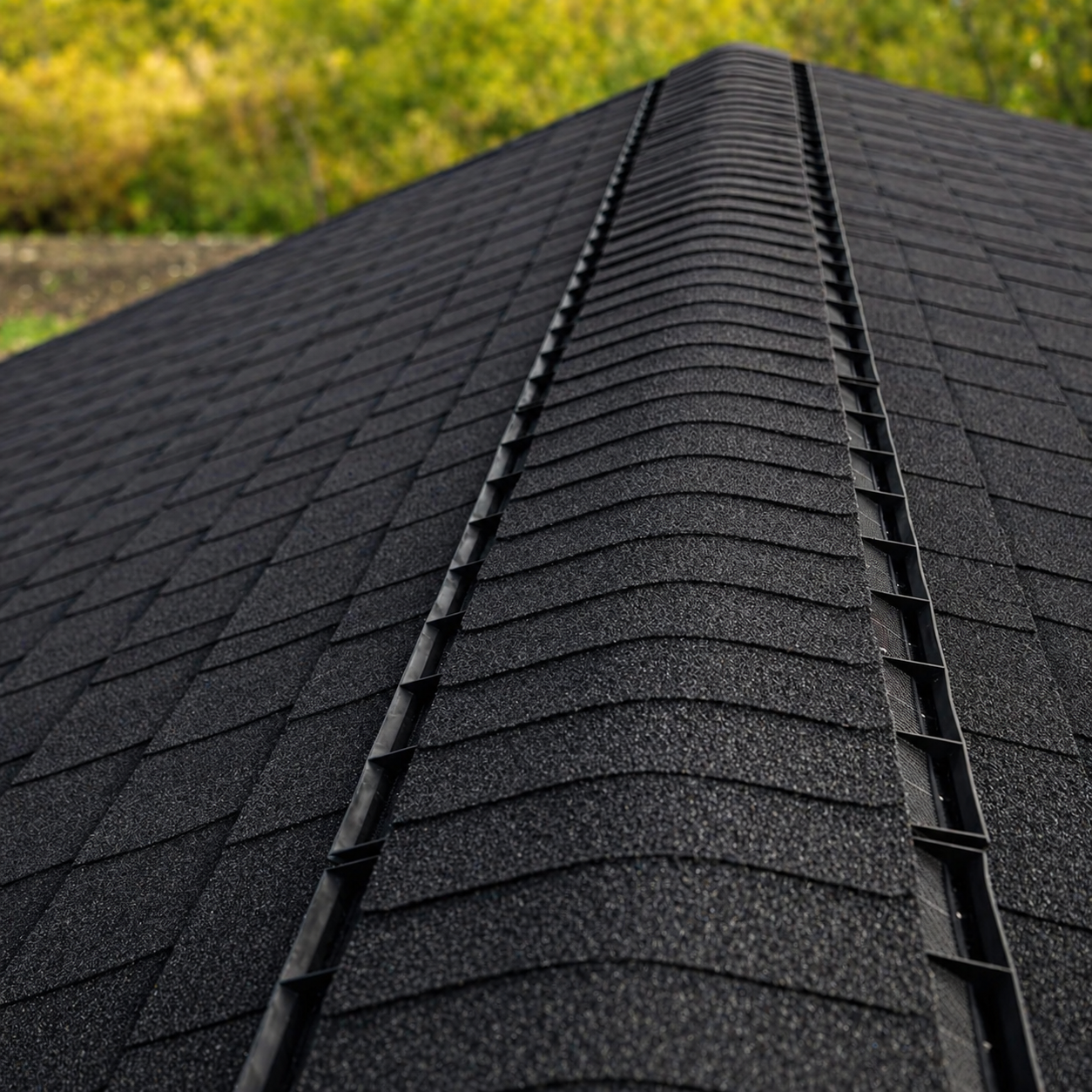
Ridge Vents run along the very peak of your roof. They are the most efficient passive exhaust system because they allow hot air to escape from the highest point. We cover them with matching shingles, so they look seamless.
Box Vents (or turtle vents) are square, static vents placed near the top of the roof. We use these when a roof's design doesn't allow for a long, continuous ridge vent.
3. Active Exhaust: Powered & Turbine Vents
Sometimes passive airflow isn't enough. Turbine vents (whirlybirds) use the wind to actively suck hot air out of the attic. Powered vents (often solar-powered today) use a fan to aggressively exhaust heat and moisture.
The "1/150 Rule"
In the roofing industry, the gold standard is the 1/150 rule: you need one square foot of ventilation for every 150 square feet of attic space. A perfectly balanced system will completely cycle the air in your attic 10 to 12 times every single hour.
If your contractor just slapped some shingles on without calculating your ventilation needs, they didn't do you any favours.